Free Chair Tai Chi Exercises & Guides
Discover the gentle art of chair tai chi — a safe, seated form of tai chi designed for seniors, beginners, and anyone with limited mobility.
Follow our free interactive video course and learn every movement with a friendly on-screen instructor — step by step, at your own pace.
🎁 100% Free — No registration required


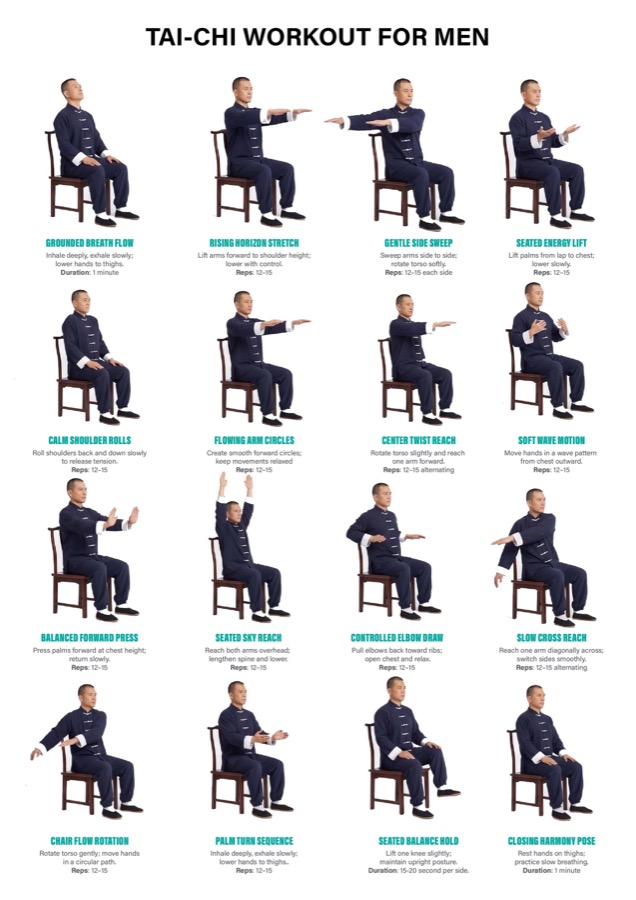
Men's version
Strength, balance, posture, and steady daily practice cues.
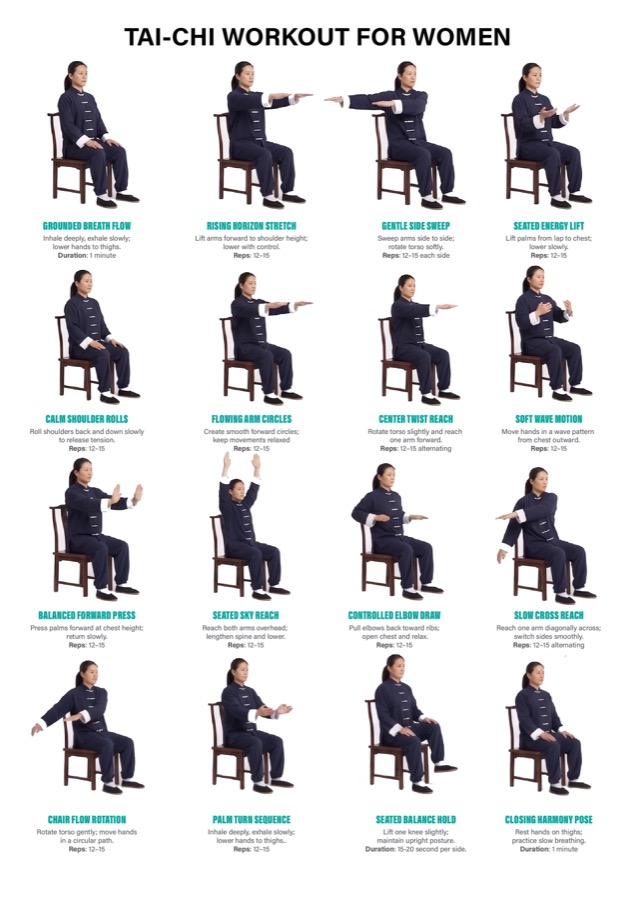
Women's version
Gentle mobility, breath, range, and calm practice cues.
Men + Women printable bundle
Download the Chair Tai Chi Printable Pack for Men and Women
A polished pair of one-page seated tai chi workout sheets for home practice, classes, caregivers, and local print shops. The bundle includes separate men and women versions, each delivered as A4 and US Letter PDFs plus high-resolution JPG files.
One-time Stripe payment. Enter your email once, then use the same email to download again without logging in.
Two versions included
Separate men and women sheets with different tone, emphasis, and practice cues.
Eight files total
Men and women versions each include A4 PDF, US Letter PDF, A4 JPG, and US Letter JPG.
At-a-glance routines
Simple seated movement sequences with short breathing, posture, and repetition cues.
Email download access
After payment, the purchase is saved to D1 so the same email can download again without an account.
About Chair Tai Chi
What Is Chair Tai Chi?
Chair tai chi is a gentle, modified form of traditional tai chi performed while seated in a chair. This accessible practice adapts the flowing movements, deep breathing, and mindfulness of tai chi for people who prefer or need the stability of a chair. Chair tai chi is especially popular among seniors, individuals recovering from injury, and anyone seeking a low-impact exercise that improves flexibility, balance, and mental well-being.
Gentle & Safe Seated Movements
Chair tai chi adapts traditional tai chi movements for seated practice. Each exercise focuses on smooth, flowing arm motions, gentle torso rotations, and mindful breathing — all performed safely from a sturdy chair.
Perfect for Seniors & Beginners
Whether you are a senior looking for gentle exercise, a beginner exploring tai chi, or someone with limited mobility, chair tai chi provides an accessible entry point. No prior experience is needed to start your chair tai chi journey.
Evidence-Based Health Benefits
Research published in medical journals shows that chair tai chi can reduce pain, improve flexibility, lower blood pressure, enhance balance, and boost mental well-being. Chair tai chi is recommended by the Arthritis Foundation and medical professionals.
Practice Anywhere, Anytime
All you need is a sturdy chair. Practice chair tai chi at home, in the office, at a community center, or in a care facility. Chair tai chi requires no special equipment and can be done in just 10–15 minutes a day.
Health Benefits
Benefits of Chair Tai Chi
Chair tai chi offers a wide range of physical and mental health benefits backed by scientific research. Here are the key reasons to start practicing chair tai chi today.
Improved Flexibility & Joint Mobility
Regular chair tai chi practice gently stretches muscles and increases range of motion in shoulders, arms, wrists, and the spine. A systematic review in the International Journal of Nursing Studies (2021) found that sitting tai chi leads to significant improvements in physical health outcomes for people with limited mobility. The Arthritis Foundation specifically recommends tai chi as a safe exercise for arthritis management.
Better Balance & Fall Prevention
A landmark 2018 clinical trial of 670 older adults published in JAMA Internal Medicine found that tai chi reduced falls by 58% compared to stretching exercises (Li et al., 2018). Chair tai chi strengthens core muscles and improves proprioception — your body's sense of its position in space. The U.S. Department of Veterans Affairs (2025) rates the evidence for tai chi in fall prevention as 'high certainty.'
Stress Relief & Mental Clarity
Often called 'meditation in motion,' chair tai chi combines slow movements with deep breathing and mindfulness. A 2022 study in Stroke (American Heart Association) found that seated tai chi significantly reduced depressive symptoms in stroke survivors (Zhao et al., 2022). Harvard Medical School reports that tai chi may also slow cognitive decline in seniors and improve sleep quality.
Pain Management
A landmark study published in the New England Journal of Medicine (Wang et al., 2010) demonstrated that tai chi reduced fibromyalgia symptoms by 42% — outperforming aerobic exercise. Chair tai chi's gentle, flowing movements provide similar pain relief for arthritis, chronic back pain, and tension headaches without the risks of high-impact exercise.
Cardiovascular & Respiratory Health
Research published in the Journal of Hypertension (2020) shows tai chi can lower systolic blood pressure by 5–10 mmHg. For people with COPD, a study in The Lancet Respiratory Medicine (2022) found a 300% improvement in exercise endurance. Harvard Health reports that tai chi offers cardiovascular benefits comparable to moderate aerobic exercise.

How to Start Chair Tai Chi
Getting started with chair tai chi is simple and requires no special equipment. Follow these steps to begin your seated tai chi practice today.
Choose Your Chair
Select a sturdy chair without wheels or armrests (if possible). Sit toward the front edge of the seat with your feet flat on the floor, hip-width apart. Keep your back straight but relaxed — imagine a string gently pulling the crown of your head upward.
Learn Basic Chair Tai Chi Movements
Start with our free chair tai chi exercises page. Begin with simple movements like Opening Form, Cloud Hands, and Parting the Wild Horse's Mane. Each exercise includes step-by-step instructions with images.
Practice Mindful Breathing
Breathe slowly and deeply through your nose during all chair tai chi movements. Inhale as you extend or raise your arms, exhale as you return or lower them. This breathing pattern enhances the calming benefits of chair tai chi.
Build a Daily Chair Tai Chi Routine
Start with 10 minutes of chair tai chi each day and gradually increase to 20–30 minutes. Consistency is more important than duration. A daily chair tai chi routine can transform your flexibility, balance, and mental well-being.
Chair Tai Chi Exercises & Resources
Explore our comprehensive library of free chair tai chi resources. Every guide, exercise, and video is 100% free — no login required.
Chair Tai Chi — Backed by Science
Tai chi's health benefits are supported by hundreds of clinical trials and endorsed by Harvard Medical School, Mayo Clinic, the NHS, and the National Institutes of Health.
Fall reduction in a 670-person clinical trial (Li et al., JAMA Internal Medicine, 2018)
Fibromyalgia symptom improvement — tai chi outperformed aerobic exercise (Wang et al., NEJM, 2010)
Per day recommended by the Arthritis Foundation for meaningful health benefits
What Research Participants Report
These experiences reflect common outcomes reported in clinical trials of seated tai chi. Individual results may vary — consult your healthcare provider before starting any exercise program.
Tai chi is a safe and effective exercise for people with arthritis. It reduces pain, improves flexibility, and enhances quality of life. The Arthritis Foundation strongly recommends tai chi for managing osteoarthritis symptoms.

Arthritis Foundation
Official Recommendation
Seated tai chi helped me regain arm mobility and reduced my depression after stroke. The 12-week program matched the results of conventional rehabilitation — but I could do it from my chair at home.

Clinical Trial Participant
Stroke Recovery Study (Zhao et al., 2022)
Tai chi is often described as 'meditation in motion,' but it might well be called 'medication in motion.' There is growing evidence that this mind-body practice has value in treating or preventing many health problems.

Harvard Health Publishing
Medical Review
Tai chi is one of the most effective exercise interventions for reducing falls in older adults. The CDC's STEADI initiative includes tai chi as a recommended evidence-based fall prevention program.

U.S. CDC / STEADI Program
Fall Prevention Initiative
After 12 weeks of tai chi, my fibromyalgia symptoms improved by 42%. The researchers found tai chi was more effective than aerobic exercise for managing my condition — and the gentle pace made it something I could stick with.

Clinical Trial Participant
Fibromyalgia Study (Wang et al., NEJM 2010)
Tai Chi for Arthritis and Fall Prevention is recognized by the NCOA as an evidence-based program. Research shows participants experience improved balance, strength, flexibility, and reduced pain across 8- to 16-week programs.

NCOA (National Council on Aging)
Evidence-Based Program
Frequently Asked Questions About Chair Tai Chi
Have questions about chair tai chi? Here are evidence-based answers to the most common questions.
What is chair tai chi and who is it for?
Chair tai chi is a modified form of traditional tai chi performed while seated in a sturdy chair. It adapts the flowing, meditative movements and deep breathing of classical tai chi — often based on Sun style or Yang style forms — for people who cannot stand for extended periods. It is recommended by the CDC, the Arthritis Foundation, and the National Council on Aging (NCOA) for seniors, people with arthritis or chronic pain, individuals recovering from stroke or surgery, wheelchair users, and anyone seeking gentle, low-impact exercise.
What does the research say about the health benefits?
Chair and seated tai chi have been studied in multiple randomized clinical trials. A 2018 JAMA Internal Medicine study of 670 adults found tai chi reduced falls by 58% (Li et al.). A New England Journal of Medicine study showed tai chi reduced fibromyalgia symptoms by 42%, outperforming aerobic exercise (Wang et al., 2010). A 2022 Stroke (AHA) study demonstrated seated tai chi matches conventional rehabilitation for stroke survivors (Zhao et al.). The NIH's National Center for Complementary and Integrative Health confirms benefits for balance, pain management, blood pressure, and mental health.
Do I need any special equipment?
No special equipment is needed. All you need is a sturdy, non-rolling chair without wheels — a standard dining chair works well. Avoid rolling office chairs for safety. Wear comfortable, loose-fitting clothing and flat, supportive shoes or grippy socks. Practice on a non-slip surface. That's it — chair tai chi can be practiced anywhere you have a stable chair.
How often should I practice for real results?
Clinical trials showing significant health improvements typically use a protocol of 2–3 sessions per week, each lasting 20–60 minutes, for at least 12 weeks. However, even 10–15 minutes of daily practice can provide meaningful benefits for beginners. The Arthritis Foundation recommends at least 15 minutes per day. Dr. Paul Lam's NCOA-recognized Tai Chi for Arthritis program is structured as 8 weeks (twice weekly) or 16 weeks (once weekly) of 1-hour sessions.
Is chair tai chi safe for people with arthritis?
Yes — the American College of Rheumatology and the Arthritis Foundation both 'strongly recommend' tai chi for managing osteoarthritis of the knee and hip. A 2021 systematic review of 16 studies with 986 participants confirmed tai chi is beneficial for knee osteoarthritis management. The gentle, low-impact movements reduce joint stiffness and pain without putting excess stress on the joints. Always consult your doctor before starting any new exercise program, especially if you have severe osteoporosis or recent joint surgery.
What conditions can chair tai chi help with?
Research supports chair tai chi for multiple conditions: osteoarthritis (strong evidence — ACR/AF endorsed), fall prevention (strong evidence — CDC STEADI endorsed), stroke recovery (Zhao et al., Stroke 2022), fibromyalgia (Wang et al., NEJM 2010), COPD and respiratory conditions (Lancet Respiratory Medicine 2022), Parkinson's disease (improved balance and mobility), hypertension (5–10 mmHg systolic reduction), depression and anxiety, type 2 diabetes, and chronic pain. Always consult your healthcare provider about which exercises are appropriate for your specific condition.
What's the difference between chair tai chi and chair yoga?
Both are gentle seated exercises, but they differ in origin, movement style, and focus. Chair tai chi emphasizes continuous, flowing movements inspired by Chinese martial arts, with a focus on weight shifting, coordination, and balance training through dynamic motion. Chair yoga adapts Indian yoga postures for seated practice, emphasizing static holds, stretching, and flexibility. Research shows tai chi is particularly effective for fall prevention and balance (CDC-endorsed), while yoga excels at flexibility. Many practitioners enjoy both.
Start Your Chair Tai Chi Journey Today
Join millions who have discovered the gentle, healing power of chair tai chi. All exercises and guides are completely free.