Chair Tai Chi Exercises — Complete Free Guide
Master every chair tai chi exercise with our free, detailed step-by-step instructions.
Each chair tai chi exercise below includes clear descriptions, breathing cues, and modification tips for all ability levels.

Essential Chair Tai Chi Exercises
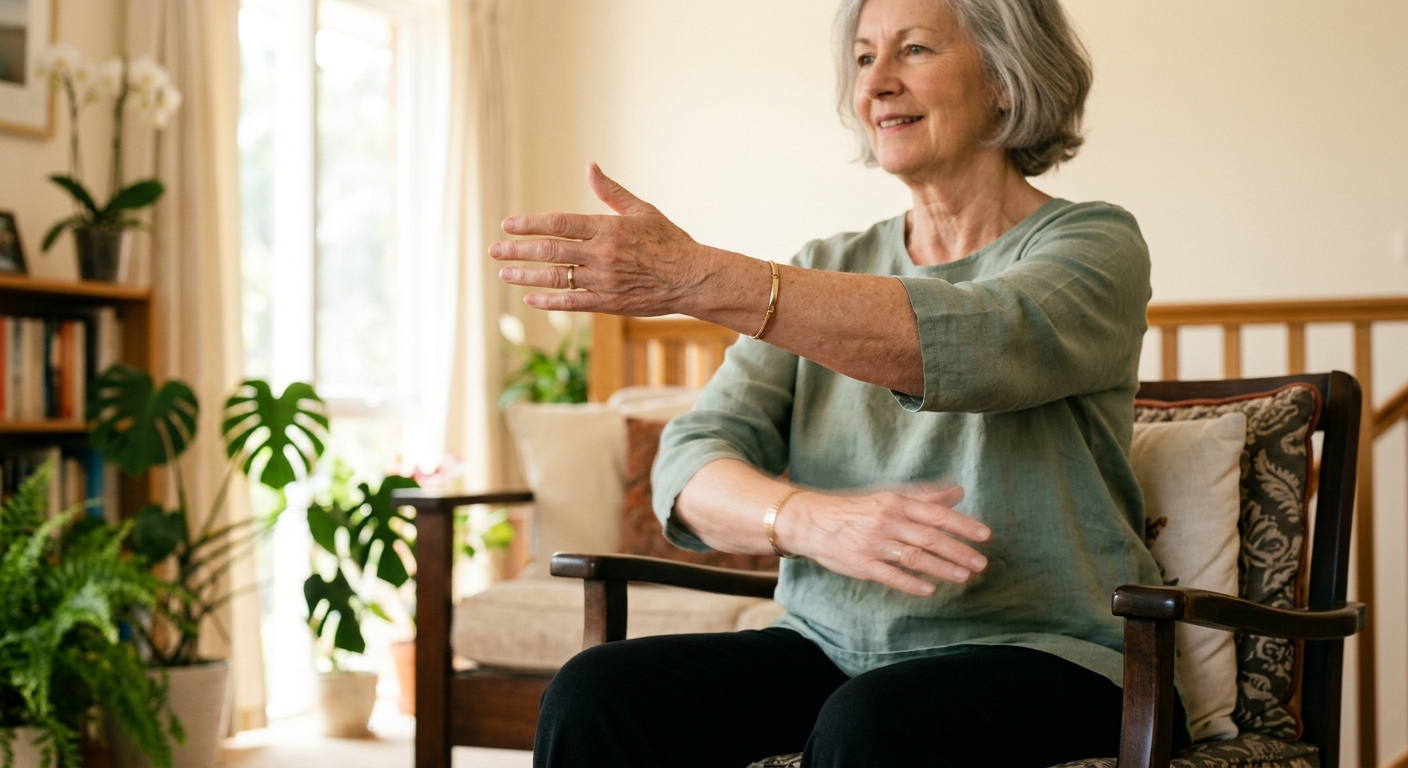
These chair tai chi exercises form the foundation of a complete seated tai chi practice. Each chair tai chi exercise can be performed independently or combined into a flowing routine. Practice these chair tai chi exercises in order for the best experience, or choose individual exercises to focus on specific areas.
1. Opening Form — Wuji (无极)
Sit in the center of the chair (not leaning on the backrest), feet flat and hip-width apart. Place hands on thighs, palms down. Close your eyes or soften your gaze. Imagine a thread gently pulling the crown of your head upward. Drop your shoulders away from your ears. Breathe naturally for 5–6 slow cycles: inhale through the nose for 4 counts, exhale through the mouth for 6 counts. This is not passive sitting — it's active centering. Time: ~1 minute.
2. Cloud Hands — Yun Shou (云手)
The most fundamental tai chi movement. Raise your right hand to face height (palm toward you) while your left hand stays at hip level (palm down). INHALE as you slowly sweep the right hand to the left across your body, rotating your torso and following with your eyes. As the right hand reaches the left side, begin raising the left hand and lowering the right — the hands 'trade places.' EXHALE as the left hand sweeps right. The power comes from rotating your waist, not your arms. Keep shoulders relaxed. Repeat 8–10 times per side. Common mistake: moving the arms without rotating the torso. Time: ~2 minutes.
3. Parting Wild Horse's Mane — Ye Ma Fen Zong (野马分鬃)
Begin with hands in front of your chest as if holding a ball (right hand on top, left underneath). INHALE to prepare. EXHALE as you extend your right arm diagonally up and forward (palm up), while your left hand pushes gently down beside your left hip (palm down). Rotate your torso toward the extending hand. Hold briefly and feel the stretch across your chest. INHALE as you return both hands to the ball position, switching (left on top). Alternate for 6–8 repetitions per side. Safety tip: don't over-reach — extend only as far as comfortable. Time: ~2 minutes.
4. White Crane Spreads Wings — Bai He Liang Chi (白鹤亮翅)
Start with both hands in front of your chest. INHALE and slowly raise your right hand above your head (palm facing left), while your left hand lowers to beside your left knee (palm down). Feel the gentle stretch along your left side. Hold for one breath. EXHALE as you return both hands to the starting position. Switch sides: left hand rises, right hand lowers. Repeat 5–6 times per side. Key cue: don't lean sideways — grow tall through the spine as the top hand rises. Imagine your body as a crane's spreading wings. Time: ~1.5 minutes.
5. Brush Knee and Push — Lou Xi Ao Bu (搂膝拗步)
Place your right hand near your right ear (palm forward, as if about to push). INHALE and prepare. EXHALE as your right hand pushes forward at chest height, while your left hand sweeps across and past your left knee in a brushing motion. Rotate your torso slightly left as you push. INHALE as you return to center and switch hands. Alternate for 6–8 repetitions per side. The push should feel like pressing against a wall of water — slow and controlled, with power from the waist, not the arm. Common mistake: pushing from the shoulder instead of rotating the waist. Time: ~2 minutes.
6. Grasp the Peacock's Tail — Lan Que Wei (揽雀尾)
This four-part sequence represents the core 'energies' of tai chi. WARD OFF: Raise forearms in a circular shape, deflecting gently upward. ROLL BACK: Rotate your waist right, drawing both hands to the right as if redirecting something past you. PRESS: Bring hands together, one palm pressing the back of the other, push gently forward. PUSH: Separate hands shoulder-width, palms forward, push both forward while exhaling. Repeat the full sequence 4–5 times, then mirror to the other side. Feel each movement distinctly before flowing them together. Time: ~2 minutes.
7. Waving Hands in Clouds — Yun Shou (云手 variation)
A more meditative version of Cloud Hands with added weight shifts. Both hands at waist level, palms down. Slowly raise the right hand to shoulder height while turning your waist right, eyes following. As the right reaches shoulder height, begin lowering it while raising the left. Turn waist left. The hands move continuously like drifting clouds — one always rising as the other falls. Subtly shift your weight from one sit-bone to the other as you turn. This improves seated balance and mimics standing tai chi's weight transfer. Continue for 1–2 minutes at a slow, rhythmic pace. Time: ~2 minutes.
8. Closing Form — Shou Shi (收势)
Slowly bring both hands to rest in front of your lower belly (dantian area), palms facing up, fingertips almost touching. INHALE and slowly raise hands to chest height. Turn palms to face down. EXHALE and slowly lower hands back to your thighs. Rest hands on thighs, palms down. Close your eyes and take 3 slow, deep breaths. Notice how your body feels compared to when you started. Don't rush the closing — this is where you 'seal in' the benefits of your practice. Sit quietly for 30 seconds before standing. Time: ~1 minute.
Chair Tai Chi Exercise Tips
Follow these tips to get the most out of your chair tai chi exercises and build a safe, effective practice routine.
Chair Tai Chi Exercises FAQ
Common questions about practicing chair tai chi exercises at home.
Ready to Practice Chair Tai Chi Exercises?
Explore more resources to enhance your chair tai chi exercise practice.