Seated Tai Chi Exercises — Complete Movement Library
This comprehensive library of seated tai chi exercises provides detailed instructions for every movement in the seated tai chi repertoire. Whether you are a beginner learning your first seated tai chi exercises or an experienced practitioner seeking to refine your technique, this complete guide covers each exercise in depth with breathing coordination, common mistakes, and modification options.
Foundation Seated Tai Chi Exercises
These foundational seated tai chi exercises should be mastered first before progressing to intermediate movements.
1. Standing Pole (Zhan Zhuang) — Seated Version
Despite its name, this foundational seated tai chi exercise is about stillness, not standing. Sit with proper posture — feet flat, spine naturally upright, shoulders relaxed. Place your hands on your thighs. Close your eyes and breathe naturally for 2–3 minutes. This seated tai chi exercise develops the internal awareness and body scanning ability that makes all other seated tai chi exercises more effective. It may seem simple, but Standing Pole is considered the most important seated tai chi exercise by many traditional teachers.
2. Dantian Breathing
Place both hands on your lower abdomen. Inhale through your nose, directing the breath into your belly so your hands push gently outward. Exhale through your nose, allowing your belly to naturally deflate. This seated tai chi exercise teaches diaphragmatic breathing — the breathing method used in all other seated tai chi exercises. Practice 10 cycles. Over time, extend your inhale and exhale counts for deeper relaxation.
3. Silk Reeling (Chan Si Gong) — Seated Adaptation
Silk Reeling is a circular movement that characterizes many seated tai chi exercises. Extend one arm in front of you and slowly trace a large circle in the air, as if pulling a silk thread without breaking it. The circle should be smooth, continuous, and driven by your wrist and forearm. Repeat 8 circles forward, then 8 backward. Switch arms. This seated tai chi exercise develops the smooth, continuous movement quality essential for all other seated tai chi exercises.
Core Seated Tai Chi Exercises
These are the primary seated tai chi exercises that form a complete practice routine.
4. Opening Form (Qi Shi)
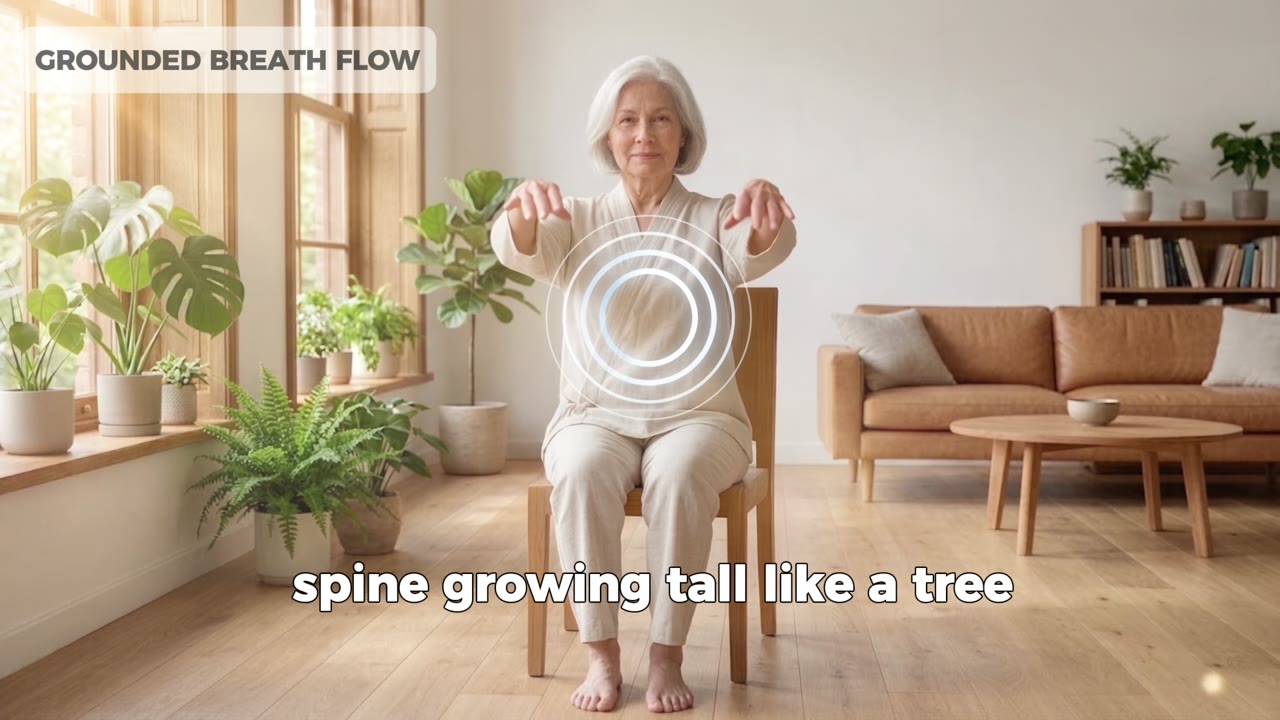
The most practiced of all seated tai chi exercises. Slowly raise both arms to shoulder height (inhale), pause, then slowly lower them (exhale). Your hands should float up like balloons and sink down like leaves falling. This seated tai chi exercise appears simple but teaches the fundamental principle of all seated tai chi exercises: movement follows breath, breath follows intention.
5. Cloud Hands (Yun Shou)
Arguably the most therapeutic of all seated tai chi exercises. Position one hand at chin height, the other near your belly. Turn your waist as the hands trace sweeping arcs, crossing at the center and swapping positions. The waist drives every aspect of this seated tai chi exercise — your arms are passengers, not drivers. Practice 8–12 repetitions per side. Cloud Hands improves shoulder mobility, develops core engagement, and teaches the essential waist-driven movement of seated tai chi exercises.
6. Parting the Wild Horse's Mane (Ye Ma Fen Zong)
Hold an imaginary ball between your hands. Rotate your torso and "part" the ball — one hand sweeps upward to shoulder height while the other presses downward toward your hip. Return to center, reform the ball with hands reversed, and repeat on the other side. This seated tai chi exercise develops bilateral coordination and the separation of yin (pressing down) and yang (rising up) energies.
7. Brush Knee and Twist Step (Lou Xi Ao Bu)
Raise one hand beside your ear while the other sweeps across your knee in a brushing motion. The raised hand pushes forward at chest height while the brushing hand settles by your hip. This seated tai chi exercise combines multiple planes of movement — forward push, lateral sweep, and trunk rotation — making it one of the most comprehensive seated tai chi exercises for upper body development.
8. Grasp the Peacock's Tail (Lan Que Wei)
This multi-part seated tai chi exercise sequence includes Ward Off (Peng), Roll Back (Lu), Press (Ji), and Push (An). Each component flows into the next: Peng creates a protective shield with the forearm; Lu draws energy backward; Ji presses forward with joined hands; An pushes with separated palms. This is the most complex of the core seated tai chi exercises but offers the deepest martial arts understanding.
Advanced Seated Tai Chi Exercises
These seated tai chi exercises build on the foundation and core exercises above.
9. Single Whip (Dan Bian)
Form a "beak" with one hand (all fingertips touching) while extending the opposite arm at shoulder height. Rotate your waist to open your chest. This seated tai chi exercise stretches the pectoral muscles and develops awareness of the body's center line.
10. Fair Lady Works at Shuttle (Yu Nu Chuan Suo)
Cross your arms in front of your chest, then open them as you rotate your torso — one arm extends to the side while the other blocks upward. This elegant seated tai chi exercise develops rotational power and arm independence.
Creating a Complete Seated Tai Chi Exercise Routine
Arrange your seated tai chi exercises in this order for a balanced 25-minute session:
- Standing Pole — 2 minutes
- Dantian Breathing — 2 minutes
- Silk Reeling — 2 minutes per arm
- Opening Form — 5 repetitions (2 minutes)
- Cloud Hands — 8 per side (3 minutes)
- Parting Wild Horse's Mane — 6 per side (3 minutes)
- Brush Knee — 4 per side (2 minutes)
- Grasp Peacock's Tail — 2 complete sequences (3 minutes)
- Closing Form — 3 repetitions (2 minutes)
Explore More Resources
- Chair Tai Chi Exercises — Our main exercise guide
- Seated Tai Chi — Philosophy and principles
- Chair Tai Chi for Seniors — Safety guides for seniors
- Chair Tai Chi for Beginners — Beginner's starting point
- Free Resources — Free PDFs and video guides
- Armchair Tai Chi — Adapted for armchair practice
- I Ching & Bazi & Feng Shui — I Ching, Bazi, and Feng Shui resources
Master these seated tai chi exercises one at a time, and you will build a practice that serves you for a lifetime. Remember: in seated tai chi, quality always matters more than quantity. One exercise performed with mindful awareness is worth ten performed carelessly.