Chair Tai Chi for Seniors — Free Printable Guide
This is a complete, printable chair tai chi guide. To save as PDF: use your browser's Print function (Ctrl+P or Cmd+P) and select "Save as PDF." You can also print this page directly.
No downloads, no signups — just print and practice.
Before You Begin: Safety Checklist
✅ Consult your doctor before starting, especially if you have a chronic condition, recent surgery, or take medications affecting balance
✅ Use a sturdy, non-rolling chair — a dining chair works best. No wheels, no rocking chairs
✅ Wear comfortable clothing and flat, supportive shoes or grippy socks
✅ Practice on a non-slip surface — avoid rugs that slide
✅ Keep water nearby and rest whenever you need to
✅ Stop immediately if you feel pain, dizziness, or shortness of breath
Who should NOT practice without medical supervision: People with recent fractures, uncontrolled blood pressure, severe osteoporosis, acute illness, or severe cognitive impairment.
Warm-Up (3 minutes)
Do these gentle warm-ups before every session:
1. Diaphragmatic Breathing (1 minute)
- Sit upright, feet flat on the floor, hip-width apart
- Place one hand on your belly, one on your chest
- Inhale slowly through your nose for 4 counts — feel your belly rise
- Exhale slowly through your mouth for 6 counts — feel your belly fall
- Repeat 5–6 times. Your chest hand should stay relatively still.
2. Shoulder Rolls (30 seconds)
- Roll both shoulders forward in slow circles, 5 times
- Reverse direction: roll backward 5 times
- Keep movements slow and gentle
3. Neck Turns (30 seconds)
- Slowly turn your head to the right, hold 3 seconds
- Return to center, then slowly turn left, hold 3 seconds
- Repeat 3 times each side. Never force the stretch.
4. Wrist & Ankle Circles (1 minute)
- Rotate both wrists in circles, 5 times each direction
- Lift one foot slightly and rotate the ankle, 5 circles each direction
- Switch feet and repeat
8 Core Chair Tai Chi Exercises
Exercise 1: Opening Form (Wuji — 无极)
Purpose: Centers the mind, establishes correct posture
Time: 1 minute
- Sit upright in the center of the chair (not leaning on the backrest)
- Feet flat on the floor, hip-width apart
- Hands resting on your thighs, palms down
- Close your eyes or soften your gaze downward
- Breathe naturally. Let your shoulders drop away from your ears
- Imagine a string gently pulling the crown of your head upward
- Hold for 5–6 slow breaths
Key point: This is not passive sitting — it's active awareness. Feel your weight evenly distributed in the chair.
Exercise 2: Cloud Hands (Yun Shou — 云手)
Purpose: Improves coordination, spinal flexibility, upper body mobility
Time: 2 minutes
- Start in the Opening Form position
- Raise your right hand to face height, palm facing you, as if holding a large ball
- Simultaneously lower your left hand to hip level, palm facing down
- Inhale as you slowly sweep your right hand to the left across your body, following with your eyes and gently rotating your torso
- As your right hand reaches the left side, begin raising your left hand and lowering your right — the hands "trade places"
- Exhale as you sweep left hand to the right
- Continue alternating for 8–10 repetitions
Key point: The power comes from rotating your waist, not from your arms. Keep your shoulders relaxed. This is the single most important tai chi movement.
Exercise 3: Parting the Wild Horse's Mane (Ye Ma Fen Zong — 野马分鬃)
Purpose: Opens chest, strengthens arms, improves posture
Time: 2 minutes
- Begin with hands in front of your chest, as if holding a ball (right hand on top, left underneath)
- Inhale and prepare
- Exhale as you extend your right arm diagonally up and forward (palm up), while your left hand pushes gently down beside your left hip (palm down)
- Hold briefly, feeling the stretch across your chest
- Inhale as you return both hands to the "holding the ball" position, switching (left hand on top)
- Exhale and extend the left arm up while right pushes down
- Alternate for 6–8 repetitions per side
Key point: Coordinate the diagonal separation of your hands with a gentle torso rotation toward the extending hand.
Exercise 4: White Crane Spreads Wings (Bai He Liang Chi — 白鹤亮翅)
Purpose: Opens the sides of the body, improves lateral flexibility
Time: 1.5 minutes
- Start with both hands in front of your chest
- Inhale and raise your right hand slowly above your head (palm facing left), while your left hand lowers to beside your left knee (palm facing down)
- Feel the gentle stretch along your left side
- Hold for one breath
- Exhale as you return both hands to the starting position
- Switch sides: left hand rises, right hand lowers
- Repeat 5–6 times per side
Key point: Don't lean — grow tall through the spine as the top hand rises. Imagine your body as the crane's spreading wings.
Practice-ready essentials
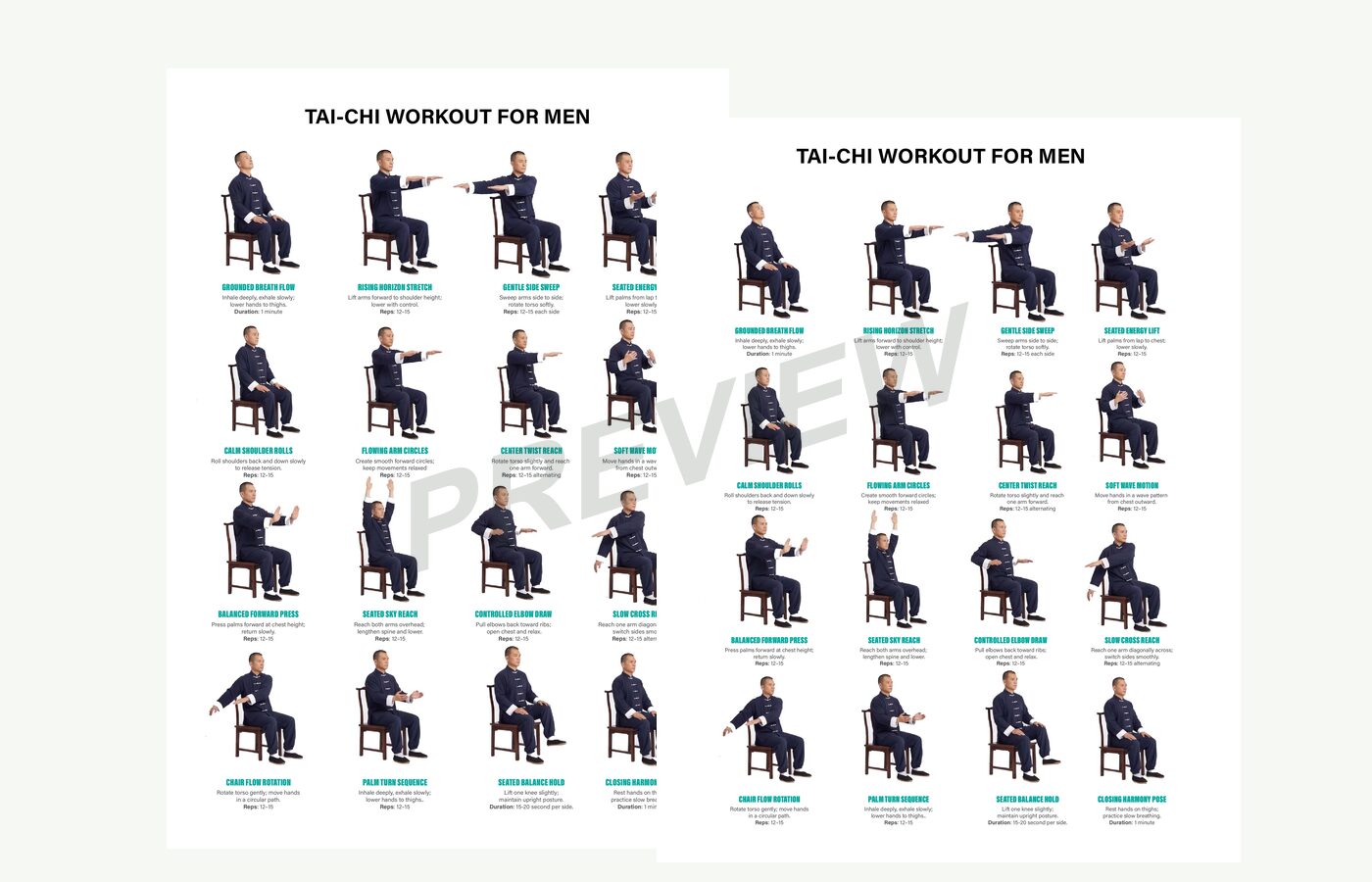
Want printable sheets for daily practice?
Get the printable pack for home, classes, and caregivers — separate men and women routines, each as A4 and US Letter PDFs plus high-resolution JPGs.
Exercise 5: Brush Knee and Push (Lou Xi Ao Bu — 搂膝拗步)
Purpose: Builds core strength, improves waist rotation
Time: 2 minutes
- Place your right hand near your right ear (palm forward, as if about to push)
- Inhale and prepare
- Exhale as your right hand pushes forward at chest height, while your left hand brushes across and past your left knee
- Rotate your torso slightly to the left as you push
- Inhale as you return to center and switch hands (left hand near left ear, right prepares to brush)
- Exhale and push with left hand while right brushes right knee
- Alternate for 6–8 repetitions per side
Key point: The push should feel like you're gently pressing against a wall of water — slow, controlled, with power from the waist, not the arm.
Exercise 6: Grasp the Peacock's Tail (Lan Que Wei — 揽雀尾)
Purpose: Combines four fundamental tai chi energies in one sequence
Time: 2 minutes
This exercise has four parts, flowing as one continuous movement:
Ward Off: Hold an imaginary ball in front of your chest. Raise your forearms, palms facing in, as if deflecting gently upward.
Roll Back: Rotate your waist slightly right, drawing both hands to the right as if redirecting something past you. Palms turn to face each other.
Press: Bring your hands together in front of your chest, one palm pressing against the back of the other hand. Push gently forward.
Push: Separate your hands shoulder-width apart, palms facing forward. Push both hands forward at chest height while exhaling.
Repeat the full sequence 4–5 times, then mirror to the other side.
Key point: These four movements represent the core "energies" of tai chi. Feel each one distinctly before flowing them together.
Exercise 7: Waving Hands in the Clouds (Yun Shou variation)
Purpose: Meditative, calming, reinforces coordination
Time: 2 minutes
- Both hands at waist level, palms facing down
- Slowly raise the right hand to shoulder height while turning your waist right, eyes following your hand
- As the right hand reaches shoulder height, begin lowering it while raising the left hand
- Turn your waist left, eyes following the rising left hand
- The hands move continuously like clouds drifting — one always rising as the other falls
- Continue for 1–2 minutes, finding a slow, rhythmic pace
Key point: This is a more flowing, meditative version of Cloud Hands. Let the movement become almost automatic. Focus on your breathing and the sensation of your hands moving through the air.
Exercise 8: Closing Form (Shou Shi — 收势)
Purpose: Returns the body and mind to calm
Time: 1 minute
- Slowly bring both hands to rest in front of your lower belly, palms facing up, fingertips almost touching
- Inhale and slowly raise your hands to chest height
- Turn palms to face down
- Exhale and slowly lower your hands back to your thighs
- Rest your hands on your thighs, palms down
- Close your eyes and take 3 slow, deep breaths
- Notice how your body feels compared to when you started
Key point: Don't rush the closing. This is where you seal in the benefits of your practice.
Cool-Down (2 minutes)
Gentle Seated Stretch
- Interlace fingers and stretch arms overhead, palms to ceiling (hold 10 seconds)
- Gently twist torso right, hold 10 seconds. Twist left, hold 10 seconds.
- Extend one leg, flex the foot, hold 10 seconds. Switch legs.
Final Breathing
- 5 slow diaphragmatic breaths (same as warm-up)
- Open your eyes slowly. Wiggle your fingers and toes.
- Stand up slowly if you're ready, holding the chair for support if needed.
4-Week Progressive Schedule
Week 1: Learning (3 days, 10 min each)
- Warm-up + Exercises 1, 2, 8 (Opening, Cloud Hands, Closing)
- Focus on breathing and posture, not perfection
Week 2: Building (4 days, 15 min each)
- Warm-up + Exercises 1, 2, 3, 4, 8
- Add Parting Wild Horse's Mane and White Crane Spreads Wings
Week 3: Expanding (4 days, 15–20 min each)
- Warm-up + Exercises 1–6, 8
- Add Brush Knee and Grasp the Peacock's Tail
Week 4: Complete Routine (5 days, 20 min each)
- Full warm-up + All 8 exercises + Cool-down
- You now have a complete chair tai chi practice!
Weeks 5–12+: Maintain & Deepen
- Practice 3–5 times per week, 15–20 minutes
- Clinical trials showing significant benefits use 2–3 sessions per week for 12+ weeks (Li et al., JAMA Internal Medicine, 2018)
Quick Reference: Exercise Summary
| # | Exercise | Chinese Name | Key Focus | Breaths |
|---|---|---|---|---|
| 1 | Opening Form | Wuji (无极) | Centering, posture | 5–6 |
| 2 | Cloud Hands | Yun Shou (云手) | Coordination, spine | 8–10 each |
| 3 | Part Wild Horse's Mane | Ye Ma Fen Zong (野马分鬃) | Chest, arms | 6–8 each |
| 4 | White Crane Spreads Wings | Bai He Liang Chi (白鹤亮翅) | Side stretch | 5–6 each |
| 5 | Brush Knee and Push | Lou Xi Ao Bu (搂膝拗步) | Core, waist | 6–8 each |
| 6 | Grasp Peacock's Tail | Lan Que Wei (揽雀尾) | Four energies | 4–5 cycles |
| 7 | Waving Hands in Clouds | Yun Shou (云手) | Meditation, flow | 1–2 min |
| 8 | Closing Form | Shou Shi (收势) | Calm, integration | 3 deep |
More Resources
- Chair Tai Chi Exercises — Expanded online exercise library
- Best YouTube Videos — Free follow-along video recommendations
- 4-Week YouTube Practice Plan — Video-based progressive schedule
- Chair Tai Chi for Seniors — Health benefits and safety guide
- Chair Tai Chi for Beginners — Getting started fundamentals
- I Ching & Bazi & Feng Shui — I Ching, Bazi, and Feng Shui resources
This guide is for educational purposes only and is not a substitute for medical advice. Consult your healthcare provider before starting any exercise program. The exercises described are based on traditional Sun-style and Yang-style tai chi forms adapted for seated practice, consistent with programs endorsed by the CDC, NCOA, and Arthritis Foundation.