15-Minute Chair Tai Chi — Complete Daily Routine
Fifteen minutes is the sweet spot for a daily tai chi practice. The Arthritis Foundation recommends practicing tai chi for at least 15 minutes per day to see meaningful benefits in balance, flexibility, and pain management. Clinical trials on tai chi for older adults often use sessions of 20–60 minutes — but 15 minutes practiced consistently is realistic, sustainable, and genuinely effective.
This 15-minute chair tai chi routine includes a proper warm-up, five core tai chi movements, a closing form, and a cool-down. Every minute is mapped out so you can follow along without guessing. If you're new to chair tai chi, we recommend starting with our 5-Minute Chair Tai Chi Routine for a week or two first, then graduating to this fuller practice.
What You Need
- A sturdy, non-rolling chair — a dining chair or folding chair is ideal. Avoid office chairs with wheels or swivel bases.
- Comfortable clothing that allows free movement through your shoulders, arms, and hips.
- A quiet space where you won't be interrupted for 15 minutes.
- Optional: a timer or clock visible from your seat.
No special equipment, mats, or footwear required.
The 15-Minute Routine — Minute by Minute
This routine flows through seven phases: warm-up, opening form, five core exercises, closing form, and cool-down. Each phase has specific timing, movements, and breathing cues. After a few weeks of daily practice, the transitions will feel natural and you won't need to check the clock.
0:00–2:00 — Warm-Up
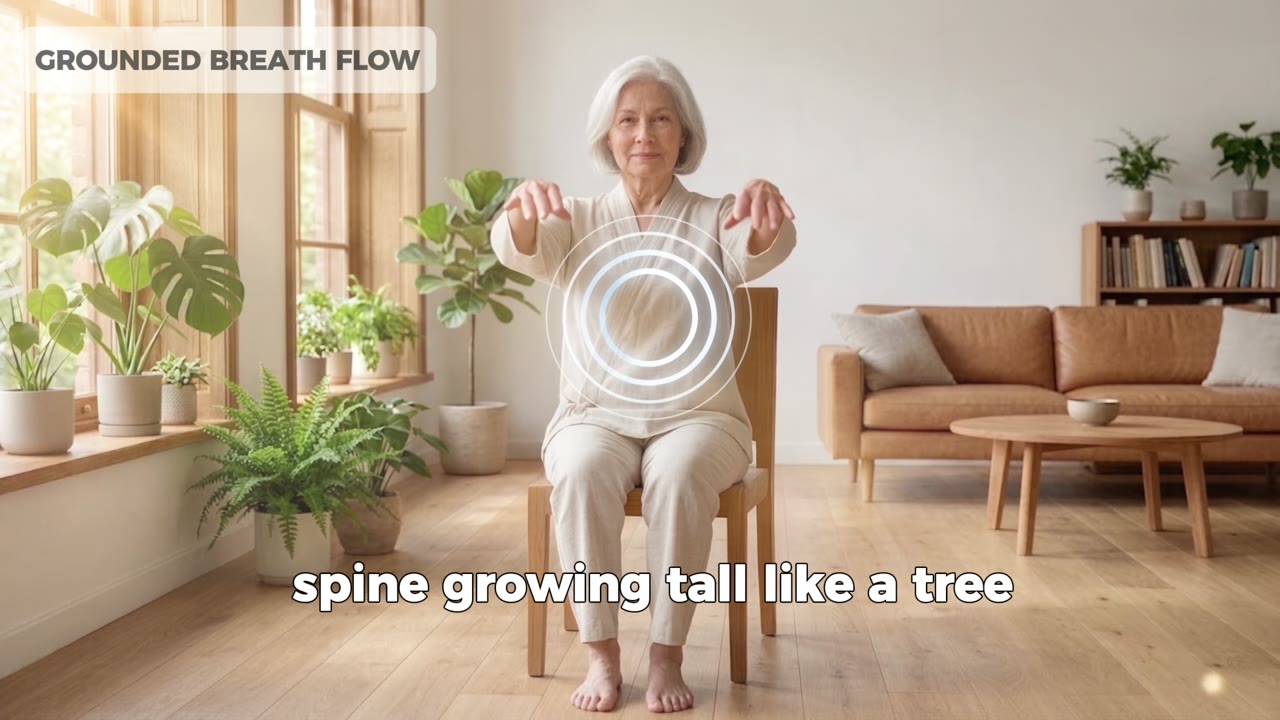
Sit tall near the front edge of your chair. Feet flat on the floor, hip-width apart. Breathe naturally as you move through these gentle warm-up exercises.
Shoulder Rolls (0:00–0:30) Roll both shoulders forward in slow, full circles — up, forward, down, and back. Complete 5 rolls forward, then reverse direction for 5 rolls backward. Make the circles as large as comfortable.
Neck Turns (0:30–1:00) Turn your head slowly to the right as far as comfortable. Hold for one breath. Return to center. Turn to the left. Hold for one breath. Return to center. Repeat for 3 turns each side. Keep your shoulders still — only your head moves.
Wrist Circles (1:00–1:30) Extend both arms in front of you. Make slow circles with your wrists — 5 circles clockwise, then 5 counterclockwise. Spread and close your fingers a few times to finish.
Ankle Circles (1:30–2:00) Lift your right foot slightly off the floor. Circle your ankle 5 times clockwise, then 5 counterclockwise. Switch to the left foot and repeat. Keep the movement slow and deliberate — this wakes up the joints that stabilize your balance.
2:00–3:00 — Opening Form (Wuji 无极)
Rest your hands on your thighs, palms down. Close your eyes or soften your gaze.
Take 5–6 slow, deep breaths. Inhale through your nose for 4 counts. Exhale through your nose for 6 counts.
With each exhale, release tension from one area: shoulders on the first breath, jaw on the second, hands on the third. By the fifth breath, your body should feel settled and still.
This is Wuji (无极) — the state of calm stillness from which all tai chi movement begins. Don't rush it. The quality of your entire practice depends on how well you settle into this moment.
3:00–5:00 — Cloud Hands (Yun Shou 云手)
Cloud Hands is the signature movement of tai chi — gentle, flowing, and deeply therapeutic for shoulder mobility and core engagement.
Starting position: One hand at chin height (palm facing you), the other near your belly (palm facing down).
The movement:
- Turn your waist slowly to the right. Your upper hand sweeps right; your lower hand begins to rise.
- At the rightward limit, your hands cross and swap positions — the high hand sinks, the low hand rises.
- Turn your waist to the left and repeat the same flowing exchange.
Breathing: Inhale as your hands open and rise. Exhale as they cross the centerline and descend.
Perform 8–10 repetitions per side (16–20 total). Each full cycle takes about 7–8 seconds. Let your waist drive the movement — your arms are passengers, not drivers. Your torso should rotate gently with each sweep.
5:00–7:00 — Parting Wild Horse's Mane (Ye Ma Fen Zong 野马分鬃)
This movement develops bilateral coordination and opens the chest while gently stretching the arms in opposite directions.
Starting position: Hold an imaginary ball between your hands in front of your chest — right hand on top, left hand underneath.
The movement:
- Rotate your torso slightly to the right.
- "Part" the ball — your right hand sweeps up and outward to shoulder height (palm up), while your left hand presses gently down toward your left hip (palm down).
- Hold for one breath. Feel the diagonal stretch across your body.
- Return both hands to center and reform the ball with hands reversed (left on top).
- Repeat to the other side.
Breathing: Inhale as you hold the ball. Exhale as you part it.
Perform 6–8 repetitions per side, alternating. Each repetition takes about 8 seconds. The movement should feel like you're gently combing a horse's mane — smooth and continuous.
7:00–9:00 — White Crane Spreads Wings (Bai He Liang Chi 白鹤亮翅)
White Crane opens the chest, stretches the sides of the body, and develops a sense of lightness and expansion in your upper body.
Starting position: Both hands together in front of your chest, as if holding a small ball.
The movement:
- Raise your right hand up and to the right (palm turning outward, as if displaying a wing) while your left hand presses gently down toward your left hip.
- At full extension, hold for one breath. Feel the stretch along your left side from hip to fingertip.
- Return both hands to center.
- Repeat on the opposite side.
Breathing: Inhale as you open into the crane position. Exhale as you return to center.
Perform 5–6 repetitions per side, alternating. Each repetition takes about 10 seconds. Imagine a crane slowly spreading its wings — the movement is broad, light, and unhurried.
9:00–11:00 — Brush Knee and Push (Lou Xi Ao Bu 搂膝拗步)
This movement combines multiple planes of motion — forward push, lateral sweep, and trunk rotation — making it one of the most comprehensive upper body exercises in seated tai chi.
Starting position: Sit tall with your hands at your sides.
The movement:
- Raise your right hand beside your right ear, palm facing forward. Simultaneously, bring your left hand across to your right hip.
- Push your right hand forward at chest height (as if gently pushing a door) while your left hand sweeps across your left knee in a brushing motion, settling near your left hip.
- Hold briefly, then return to neutral.
- Switch sides — left hand rises to the ear, right hand sweeps across the right knee.
Breathing: Inhale as you set up (hand rises to ear). Exhale as you push forward and brush across the knee.
Perform 6–8 repetitions per side, alternating. Each repetition takes about 8 seconds. The push and the brush should happen simultaneously — the coordination gets smoother with practice.
11:00–13:00 — Waving Hands in Clouds (Yun Shou 云手 — Continuous Flow Variation)
This is a variation of the Cloud Hands you performed earlier, but now practiced as a continuous, unbroken flow for two full minutes. The goal is to link movement and breath into a seamless rhythm without pausing between repetitions.
The movement: Same as Cloud Hands (hands crossing and swapping as your waist turns side to side), but add subtle weight shifts — as you turn right, let your weight settle gently into your right hip. As you turn left, shift to the left.
Breathing: Let your breathing settle into whatever rhythm matches the movement. Don't force a count — by this point in your practice, your breathing should be naturally slow and coordinated.
Practice for 2 continuous minutes without stopping. If you lose the rhythm, simply pause for one breath and resume. This sustained flow is where many practitioners report the deepest sense of calm and moving meditation.
13:00–14:00 — Closing Form (Shou Shi 收势)
Gradually slow your Cloud Hands movement and bring both hands to rest on your lower abdomen, just below your navel — the dantian (丹田).
Take 3 slow, deep breaths. Inhale for 4 counts, exhale for 6 counts.
With each exhale, feel the warmth of your palms settling into your center. This closing form gathers the energy you've cultivated over the last 13 minutes and brings your practice to a deliberate, mindful end.
14:00–15:00 — Cool-Down
Finish with three gentle stretches to release any remaining tension:
Overhead Stretch (20 seconds) Interlace your fingers and press your palms toward the ceiling. Hold for 2–3 breaths. Feel your spine lengthen. Release your hands slowly.
Seated Spinal Twist (20 seconds each side) Place your right hand on your left knee. Place your left hand behind you on the chair seat. Turn your torso gently to the left. Hold for 2 breaths. Return to center and repeat on the other side.
Final Breaths (remaining time) Rest your hands on your thighs. Take 3 final deep breaths — the slowest and deepest of the entire practice. Open your eyes. Notice how your body feels compared to when you started.
You're done.
Progression Tips
Once you've practiced this routine daily for 3–4 weeks, try these progressions:
- Link the exercises without pausing. Instead of resetting to a neutral position between movements, flow directly from one exercise to the next. Cloud Hands flows naturally into Parting Wild Horse's Mane, which flows into White Crane.
- Slow down further. Extend each repetition by 2–3 seconds. Slower movement is more challenging and more meditative.
- Add Grasp the Peacock's Tail. This classic multi-part tai chi sequence (Ward Off, Roll Back, Press, Push) fits naturally between Brush Knee and the closing Cloud Hands flow. See our Chair Tai Chi Exercises library for detailed instructions.
- Practice without counting. Once the routine is internalized, let go of the clock. Let your body tell you when it's ready to transition to the next movement.
Recommended 15-Minute Follow-Along Videos
These videos complement this routine and offer a visual reference for the movements described above:
- Seated Tai Chi for Seniors — David-Dorian Ross — 333K views, 11 min. A clearly paced seated routine from a 7-time U.S. national tai chi champion. Excellent verbal cues and front-facing "mirror" instruction.
- Seated Tai Chi for Arthritis — Dr. Paul Lam — 167K views. Created by the developer of the CDC-endorsed Tai Chi for Arthritis and Fall Prevention program.
For more video options organized by length and level, see our full guide: Best Chair Tai Chi YouTube Videos.
Related Guides
- 5-Minute Chair Tai Chi — Quick Morning Routine — Start here if 15 minutes feels like too much right now.
- Chair Tai Chi Exercises — Complete Movement Library — Detailed instructions for every movement referenced in this routine.
- Chair Tai Chi for Seniors — Complete Guide — Benefits, safety tips, and how to get started at any fitness level.
- Best Chair Tai Chi YouTube Videos — Free curated video guide organized by instructor, length, and level.
Medical Disclaimer
This routine is designed for general wellness and is not a substitute for professional medical advice. If you have a specific health condition, recent surgery, balance disorder, or chronic pain, consult your doctor or physical therapist before beginning any new exercise program. Stop any movement that causes sharp pain or dizziness.